Introduction
Dairy farming is becoming more challenging every year.
Feed prices continue to rise. Labor is harder to find and more expensive than ever. At the same time, milk prices can change quickly, making it difficult for farmers to predict their income.
So it’s no surprise that many dairy producers are asking the same question.
Is there another way to improve profits without increasing the size of the herd?
For many farms, the answer may be Beef-on-Dairy.
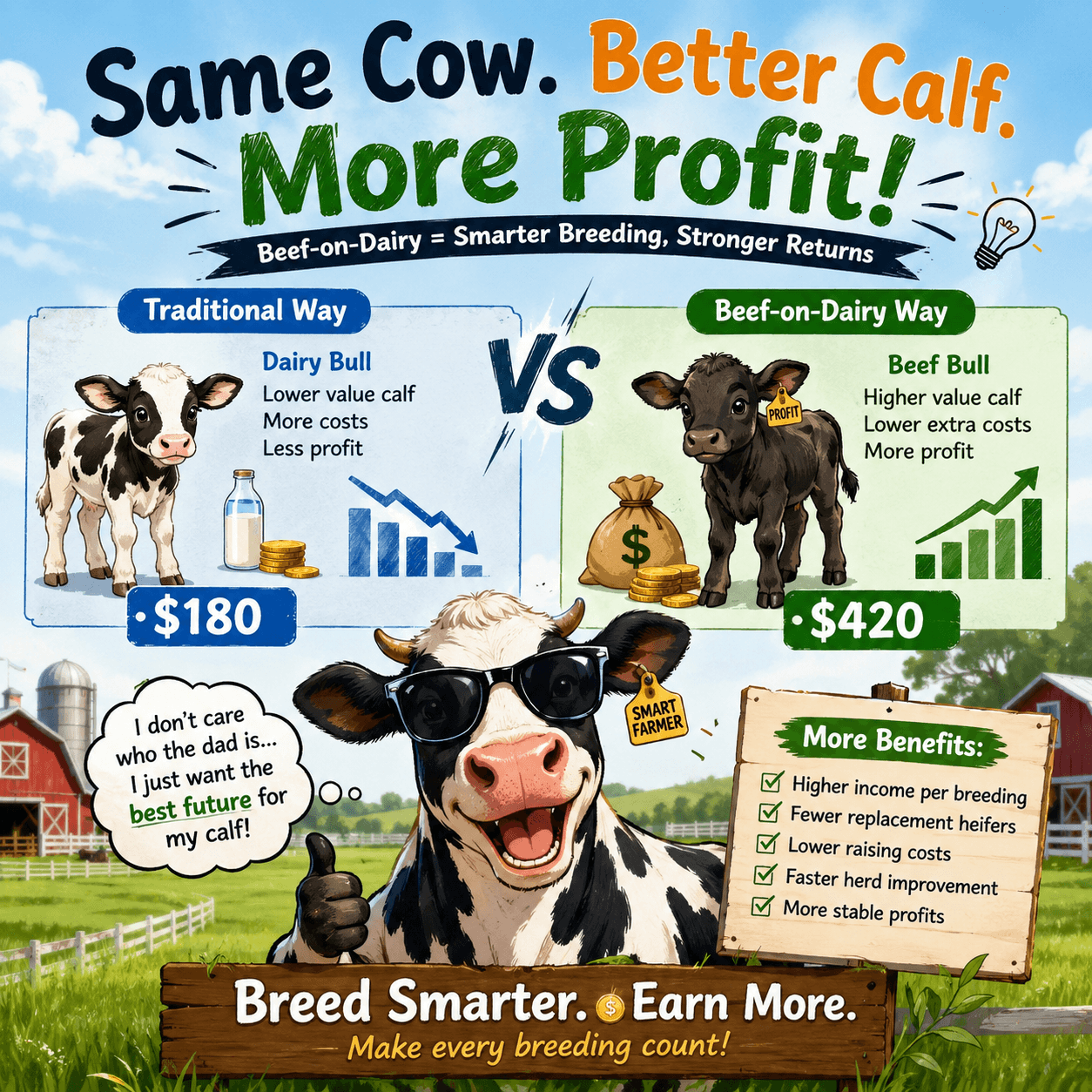
Instead of breeding every dairy cow with a dairy bull, farms now use beef bulls on cows that are not needed to produce replacement heifers. The result is a crossbred calf that is often worth significantly more than a traditional dairy bull calf.
The idea sounds simple, but does it really work? More importantly, can it make a meaningful difference to your bottom line? Let’s explore why this breeding strategy has become so popular around the world.
What Is Beef-on-Dairy?
At its core, Beef-on-Dairy is a smarter way to match breeding decisions with business goals.
Years ago, most dairy farms bred nearly every cow with a dairy bull because they wanted as many replacement heifers as possible. That approach made sense when expanding the herd was the main priority.
Today, farms have much better information. Milk production records, fertility, health data, and genetic evaluations make it easier to identify which cows should produce the next generation of dairy replacements.
The highest-performing cows continue to receive dairy semen.
The remaining cows, those that are healthy but not essential for future herd genetics, are bred with beef bulls instead.
Their calves are raised for beef production rather than dairy replacement. This allows the same pregnancy to generate a calf with much higher market value.
In other words, every breeding decision serves a specific purpose.
Why Not Breed Every Cow with a Dairy Bull?
The answer is surprisingly simple.
A dairy farm only needs a limited number of replacement heifers each year. Once that target has been reached, producing additional dairy calves often creates more cost than value.
Extra replacement animals require feed, housing, labor, vaccinations, healthcare, and months of management before they ever enter the milking herd. If too many are raised, those expenses continue to grow while returns become smaller.
Imagine planting twice as many trees as your orchard can support. You still pay for water, fertilizer, and care, but not every tree will generate additional income.
The same principle applies to dairy replacements.
That is why many progressive farms now follow a different strategy.
The best cows produce future dairy cows. The rest produce higher-value beef-cross calves.
This simple change helps farms use their resources more efficiently while improving overall profitability.
Why Are Beef-Dairy Crossbred Calves Worth More?
The biggest advantage comes from the genetics of beef breeds.
Compared with dairy breeds, beef cattle usually grow faster, develop more muscle, and produce higher carcass yields. These traits make them much more attractive to beef producers and feedlots.
Consider two calves born on the same day.
One is a standard dairy bull calf.
The other is the offspring of a Holstein cow and an Angus bull.
Although both required the same pregnancy, the Angus crossbred calf will often attract more buyers and command a higher selling price because it performs better during finishing and delivers greater value at harvest.
For the dairy farmer, nothing changes during the ten months of pregnancy.
The difference appears when the calf is sold.
One breeding decision can create noticeably more income.
More Than Higher Calf Prices
Selling more valuable calves is only part of the story.
A well-managed Beef-on-Dairy program can improve the entire economics of a dairy operation.
Some of the key benefits include:
- Higher returns from every successful breeding.
- Fewer unnecessary replacement heifers.
- Lower feed and housing costs for young stock.
- Faster genetic improvement within the dairy herd.
- A second source of income alongside milk production.
- Better protection against changing milk prices.
The result is a more balanced business.
Instead of relying only on milk sales, farms generate additional revenue from calf sales, creating greater financial stability throughout the year.
Choosing the Right Beef Bull
Success depends on selecting the right genetics.
Not every beef breed is suitable for dairy cows. If calves are born too large, difficult calving can increase health risks for both the cow and the newborn calf.
For this reason, most dairy farms choose beef sires that are known for:
- Easy calving performance.
- Low birth weight.
- Fast growth after birth.
- Excellent carcass quality.
- Reliable fertility and consistent breeding performance.
Finding the right balance is important.
The goal is to produce a valuable calf without increasing calving problems or reducing cow welfare.
Is Beef-on-Dairy Right for Every Farm?
Not necessarily.
Like any management strategy, Beef-on-Dairy works best when it matches the farm’s goals and local market conditions.
Before making the switch, it is worth asking a few practical questions.
- How many replacement heifers does the farm actually need each year?
- Which cows should continue producing future dairy replacements?
- Is there strong local demand for beef-dairy crossbred calves?
- Does the farm maintain accurate breeding and production records?
Clear answers to these questions make it much easier to build a successful breeding program and avoid costly mistakes.
Looking at the Long-Term Picture
The real strength of Beef-on-Dairy becomes more obvious over time.
Each year, the best dairy cows continue improving the herd’s genetics, while the remaining cows produce calves with higher market value.
As this cycle repeats, the dairy herd becomes more productive, replacement numbers stay under control, and calf income continues to grow.
Instead of depending on a single income source, the farm benefits from two.
Milk generates steady cash flow, while crossbred calves provide additional revenue and help reduce the financial impact of volatile milk prices.
Over several years, these small improvements can add up to a significant increase in profitability.
Conclusion
Beef-on-Dairy is no longer an experimental idea. It has become a practical breeding strategy used by dairy farms across the world to improve efficiency and increase income.
By breeding elite dairy cows with dairy sires and using carefully selected beef bulls on the remaining cows, farms can strengthen herd genetics, produce more valuable calves, and create new opportunities for profit.
Of course, every dairy operation is different. The best breeding plan depends on herd size, replacement needs, genetics, and local market demand.
If your farm has a clear breeding strategy, good records, and access to buyers for beef-cross calves, Beef-on-Dairy could become an effective way to improve long-term profitability.
Before making any changes, evaluate your replacement needs, review your breeding goals, and calculate the potential return. A well-planned Beef-on-Dairy program may be one of the simplest ways to make every breeding deliver more value.